



04/17/24
02/12/24
 Mongolian dzud: Extreme weather puts 90% of country at ‘high risk’
The ongoing “white and iron” dzud in Mongolia has reached a “critical” level, with over 90 per cent of the country facing high levels of risk from the unique weather phenomenon, UN agencies have reported. | About 190,000 herder households are struggling with inadequate feed, skyrocketing prices and heightened vulnerabilities, according to the Office of the UN Resident Coordinator in Mongolia. Herding and livestock have traditionally been integral to Mongolia’s economy, culture and way of life. Estimates indicate that there are over 64 million livestock this winter season in Mongolia. “The increasing severity of weather conditions further exacerbates the crisis, underscoring the urgent need for humanitarian assistance and sustainable solutions to support Mongolia's rural communities and traditional livelihoods,” the Office said in an update this week. This is the second year in a row that the country has faced these severe conditions. Last winter about 70 per cent of the country was affected.
■ Mongolia: Severe Winter - Iron Dzud 2024 (As of 6 February 2024) (reliefweb)
■ The Dangers of Dzud, Mongolia’s Lethal Winters (National Geographic)
11/25/23
Greta storms wind turbines in Norway
Greta Thunberg is apparently no longer fighting for renewable energy. The planned wind farms in Norway is the latest quixotic battle in which the "Fridays for Future" initiator is engaged. | The Swede, together with other climate protectors, blocked access to the Norwegian Ministry of Energy in Oslo. They are protesting against the construction of wind turbines in the west of the country, reported the AFP news agency. ● The reason for their resistance is the indigenous peoples who live in the area. “We cannot use the so-called climate change as a cover for colonialism,” said Thunberg, according to TV2, outside the ministry’s doors. “A climate transition that violates human rights is not a climate transition worthy of the name.”
08/31/23
Germany to Miss Climate Goals despite Spending over $500 Billion on Green Agenda
Germany is expected to fall far short of its ambitious “climate change” goals and will fail to comply with the globalist green agenda, according to reports. | Reuters is reporting that the German government is failing to meet the climate goals despite having spent more than $500 billion to reach them. Unfortunately for the taxpaying German public, the country isn’t even close to complying with the green agenda targets, even after the epic spending. Germany had pledged to meet targets to reduce greenhouse gas emissions by 65 percent before 2030. The country also vowed to reach “Net Zero” carbon dioxide emissions by 2050. By 2025, the German government will have spent the equivalent of at least $580 billion toward achieving the goals that it is now forecasted to miss, according to Bloomberg.
Renowned Climate Scientists Warn Public: Green Agenda Based on ‘Hoax’
Two of the world’s most renowned climate scientists have spoken out to warn the public that the green agenda being peddled by the World Economic Forum (WEF) and its globalist allies is based on a “hoax.” | As Slay News has extensively reported, governments around the world are scrambling to meet the “Net Zero” goals of the green agenda. This destructive agenda is being led by the WEF and other similarly-aligned unelected bureaucratic organizations such as the United Nations (UN) and the World Health Organization (WHO). The alleged goal of the green agenda is to fight the so-called “global warming/climate change/global boiling crisis.” However, meeting these goals means ramping up taxes, stripping the public of basic freedoms, and drastically lowering the quality of life for the general population.
■ The Great Global Warming Swindle - Full Documentary HD
08/16/23
Net zero Britain will be unable to keep the lights on, MPs warn
Green power unlikely to generate enough energy to run the country without radical reform, says Business Select Committee | Britain will struggle to keep the lights on using only net zero electricity as the roll-out of green energy lags far behind target, MPs have warned. ● Falling investor confidence and bureaucratic delays mean Britain’s efforts to produce entirely clean electricity are at risk of stalling, MPs on the cross-party Business Select Committee said. They are calling on the government to come up with a “coherent, overarching plan” to boost green supplies — or risk missing climate targets. ● Demand for electricity is expected to soar as households buy electric cars and heat pumps. Darren Jones, the Labour MP who chairs the committee, said: 💬 “Ministers think that publishing strategies and releasing social media videos will deliver the energy infrastructure the country needs. “Its failed before and it keeps failing. Without a coherent, overarching delivery plan, the Government risks undermining the UK’s ability to generate, store and distribute the fossil fuel free electricity the country needs to hit net zero.”
08/06/23
Dozens of giant turbines at Scots windfarms powered by diesel generators
Scottish Power admitted 71 of its windmills were hooked up to the fossil fuel supply after a fault developed with their power supply. | Dozens of giant turbines on Scotland’s windfarms have been powered by diesel generators, the Sunday Mail can reveal. Scottish Power admitted 71 of its windmills were hooked up to the fossil fuel supply after a fault developed on the grid. ● The firm said it was forced to act in order to keep the turbines warm during very cold weather in December. But a whistleblower has told the Sunday Mail the incident is among a number of environmental and health and safety failings. ● The worker, who asked to remain anonymous, said: “The Scottish Government wants to make our country attractive to foreign investors as 40 per cent of the wind that blows across Europe blows across Scotland. However, that should not mean we put up with our waterways and nature being polluted with carbon from diesel generators and hydraulic oil.
07/28/23
Central Bank Digital Currency Carry Enormous Risks
De-Banking Should Sound the Alarm | Cancellation of bank accounts belonging to customers who do not hold corporate-sanctioned views is a sign we’re on the road to Orwell’s dystopian nightmare. Coutts cancelling Nigel Farage’s bank account for holding unfashionable views should be a wake-up call for us all – it is just the tip of the iceberg. This politically motivated cancellation born out of “woke capitalism” is alarmingly widespread. You don’t have to agree with Farage’s politics to agree with him that something has gone terribly wrong in the institutions. Banks de-banking customers for their views is also a forewarning of the totalitarian regime that will be ushered in if central bank digital currencies (“CBDCs”) become the sole form of “currency” to buy and sell.
06/26/23
Sweden Dumps Climate Agenda, Scraps Green Energy Targets
Sweden has just dealt a severe blow to the globalist climate agenda by scraping its green energy targets. | In a statement announcing the new policy in the Swedish Parliament, Finance Minister Elisabeth Svantesson warned that the Scandinavian nation needs “a stable energy system.” Svantesson asserted that wind and solar power are too “unstable” to meet the nation’s energy requirements. Instead, the Swedish Government is shifting back to nuclear power and has ditched its targets for a “100% renewable energy” supply. The move is a major blow to unreliable and inefficient technology. Countries are being pushed toward “renewable energy” to meet the goals of the World Economic Forum’s (WEF) green agenda.
06/21/23
'Black Day for Norwegian Nature' as Oslo Plans to Open Its Waters for Deep-Sea Mining
Several studies have revealed the presence of metals ranging from copper and zinc to rare earths on the shelf, promising a lucrative business for the Norwegian government. However, critics say it runs contrary to the country's environmental commitment and may ruin its "green" image abroad. | Norway's Labor-led government has proposed opening the country's waters to deep-sea mining despite fierce opposition from environmental campaigners, political parties and even fellow European countries. ● The small country with 5.4 million inhabitants was propelled to immense wealth by its vast oil and gas reserves, which helped fill its Petroleum Fund which at more than $1 trillion ranks as the world's largest sovereign fund. Its position in Europe was cemented further after the EU's recent sanctions campaign against Russian energy, which effectively robbed the continent of a major provider, while clearing a lion's share of the market. Norway even came even under fire when it was suspected of profiteering from the energy crisis that gripped Europe. ● Now, Oslo seeks to shift from a reliance on hydrocarbons to new sources of economic activity, tapping into the high demand to transition from fossil fuels. According to the Norwegian Petroleum Directorate, there are large mineral resources on the Norwegian continental shelf, including several million tonnes of copper, zinc and cobalt, which could potentially mean large revenues for Norway.
■ Norway Opens Door for Deep-Sea Mining of Copper and Other Critical Materials (Wall Street Journal)
06/09/23
Greenpeace founder, Dr. Patrick Moore:
Greenpeace founder, Dr. Patrick Moore: “The scientific method has not been applied in such a way as to prove that carbon dioxide is causing the Earth to warm. The future will show that this whole hysteria over climate change was a complete fabrication.”pic.twitter.com/hXHJHiqgzt
— Dr. Eli David (@DrEliDavid) June 9, 2023
05/24/23
About Those Pesky Volcanos Again...
NET ZERO - Frankly, Mexico’s volcanos are just not complying with net zero diktats!
Now spewing out more carbon & toxic gas into the atmosphere in a day, than the entire worlds industries will in a year!
Ban them! Let’s show them who’s in charge!
pic.twitter.com/BjfBv3sbrg— Bernie's Tweets (@BernieSpofforth) May 24, 2023
05/20/23
Ukraine's Depleted Uranium Blast: Europe on Brink of 'Environmental Disaster'
Russian Security Council Secretary Nikolai Patrushev warned on Friday that a radioactive cloud was heading towards Western Europe following the destruction of a Ukrainian warehouse storing British-supplied depleted uranium ammunition. | Sputnik News spoke with Dr. Chris Busby, physical chemist and scientific secretary of the European Committee on Radiation Risk, about how the West’s decision to provide depleted uranium (DU) ammunition to Ukraine has potentially caused a continent-wide ecological disaster. Below is his answer in full.[...] Those who provide the weapons, the UK government in this case, are morally bankrupt. Unless it is their intention to destroy the Ukrainian people. Who knows anymore? The world has gone mad.
04/30/23
Pears grown in Argentina and then packed in plastic in Thailand and shipped all over the world...
Pears grown in Argentina and then packed in plastic in Thailand and shipped all over the world.
Humans really are this stupid 🤡 pic.twitter.com/688kRXqWko— Bernie's Tweets (@BernieSpofforth) April 12, 2023
04/18/23
The government created a lie to rob our farmers of their land
🇳🇱Our farmers are fighting against the worst kind of injustice: a government that has turned on its own people.
The government created a lie to rob our farmers of their land. But we won’t let it happen. Our #DutchFarmers are an example to the world.
My speech with 🇬🇧 subtitles. pic.twitter.com/QYiFbkR2zM— Eva Vlaardingerbroek (@EvaVlaar) March 11, 2023
■ The Netherlands provides 100 million euros IN SUPPORT TO UKRANIAN FARMERS and winter preparations
■ Netherlands Allocates $44Mln TO SUPPORT UKRANIAN FARMERS (Sputnik News)
■ Netherlands reportedly set to forcibly close 3,000 farms to comply with "EU mandate" (Fox News)
■ Dutch Farmer’s Are in Full Revolt Over WEF Control (Independent Sentinel)
■ Netherlands CRUMBLES into WEF run dictatorship, Dutch uprising spreads (Redacted)(VIDEO)
03/10/23
Russia says Nord Stream correspondence with Germany, Denmark, Sweden to be published soon
"To be transparent we will publish this whole correspondence quite soon and distribute it among the members of the Security Council," Dmitry Polyansky added | Russia will distribute the correspondence with Germany, Denmark and Sweden on the investigation of Nord Stream accidents among the members of the UN Security Council soon, First Deputy Permanent Representative to the UN Dmitry Polyansky said in an interview with The Dive YouTube channel on Thursday. 💬 "They are denying any access to information, they are denying any participation regardless of the fact that we are an affected party, so we should be part of this investigation, but they are just writing to us some letters saying that we’re doing what we’re doing and mind your own business. To be transparent we will publish this whole correspondence quite soon and distribute it among the members of the Security Council," Polyansky [said]. The recent information in Western media on Nord Stream accidents is an attempt to divert attention away from what really happened, the diplomat noted.
■ Moscow to expose Nord Stream stonewalling (RT.com) The diplomat claimed that, in a nutshell, the message from the three nations was: “We are doing what we are doing, mind your own business.” The Russian mission will distribute the exchanges among members of the UN Security Council in an effort to initiate an “independent, unbiased international investigation with all parties concerned,” Polyansky added. Moscow wants the UNSC to authorize Secretary General Antonio Guterres to launch a probe into the attack on the undersea energy links, which were built to pump Russian natural gas directly to Germany. Three of the four pipes were ruptured by explosions in September last year in the territorial waters of Denmark and Sweden. According to Polyansky, Russia intends to put its proposal to a vote by the end of March, although Western powers will inevitably object.
03/01/23
Greta Thunberg arrested in Norway: Protests Against Wind Farm
Corriere della Sera | The activist was taken away by police after several days of occupation of the Norwegian Ministry of Energy Policy | Greta Thunberg was arrested yesterday (Tuesday 28 February) in Norway because, together with Sami (people of Lapland) activists, she had been occupying the Ministry of Energy Policy in Oslo since Thursday. The activist was protesting together with indigenous people against the construction of the Fosen wind farm. ● Thunberg, together with the other activists, had blocked the entrance to the Norwegian Ministry of Energy to demand compliance with the 2021 final ruling for the dismantling of the wind turbines, which gives the Sami people a right. 'There is no ecological transition without human rights'. The turbines, however, are still there, and according to the environmentalist and Lapp activists, the wind farm would damage the reindeer herds, the primary source of livelihood for the indigenous people in the north-west of Norway. ● The police operation was triggered in the night, at around 2.30 a.m., when the police removed a dozen protesters by weight. Thunberg, along with the others, was taken to the barracks for a few hours before being released. (Translation with: DeepL.com)
■ This is how Fosen could happen (02/28/23)
02/28/23
This is how Fosen could happen

Campaigners from Nature and Youth and Norwegian Samirs Riksforbund Nuorat
have been protesting against the Ministry of Oil and Energy in Oslo since Feb. 23,
2023. The reason for the action is that the wind turbines at Fosen, which the
Supreme Court has said are illegal, have not been demolished. The picture shows
Sami artist Ella Marie Hætta Isaksen being removed by Norwegian police the night
before Monday Feb. 27. Photo: Rasmus Madsen Berg, Natur og ungdom
In October 2021, Norway’s Supreme Court ruled that two wind plants at Fosen are violating Sami rights. However, the wind farm is still operating. | On 11 October 2021, Norway’s Supreme Court unanimously found this to be in violation of Article 27 of the Convention on Civil and Political Rights, and considered the wind power plants to «deny the right to cultural exercise». The permit for the wind power plant was thus declared invalid by the court. The Supreme Court did not determine what should be done with the invalid power plant. The government says it is working to make the invalid permit compliant with SP Art 27, which is why it has not yet been dismantled or moved. The continuous violation of human rights has now lasted for 500 days with no sign of resolution. ● The business model of the wind power industry has taken a shortcut through laws and regulations to obtain permits to build and produce wind power plants. The number and size of offenses this entails varies from area to area. The Sami community should have been contacted by the developer in advance to obtain their consent, but the process was ignored, along with the information of the neighbors and other people with rights in the planning area. The municipalities should have checked in advance which laws and regulations could come into conflict with permission in this planning area, but this was not properly done due to an unclear division of com-petence. ● Norwegian energy authorities should have made sure that all rights, laws and regulations were properly managed either by themselves or by the municipality. Instead, neither the municipality nor the energy authorities have carried out the coordination obligation of the legislation, and several breaches of the law have occurred. ● As a result, the wind power plants at Fosen were built illegally, they are too big with too much noise and with too much negative impact on the grazing areas, on the reindeer and the opportunity to run reindeer herding. Reindeer herding and wind power plants are incompatible, and cannot exist together.
■ Aktivistene møtte Aasland: – Tåler ikke at du sitter og prater den samme tompraten (NRK) (DeepL.com)
■ 500 days of human rights violations are enough! | NSR Nuorat, the youth organisation of the Norwegian Sami National Association (NSR), and Nature and Youth are now marking 500 days of human rights violations. In protest against the Norwegian authorities' delay of the Fosen verdict, they have been staying in the premises of the Ministry of Petroleum and Energy since 23 February. Eleven Supreme Court judges support the unanimous Fosen ruling that Article 27 of the International Covenant on Civil and Political Rights was violated when Fosen Vind destroyed the last winter grazing areas of the Sør-Fosen Sijte and Nord-Fosen Siida.
Norway Mulls Using US Floating Nuclear Power Plants Along Its Coast
Having launched the world’s first floating nuclear power plant, the Sturgis, in the 1960s, the US currently has no active floating NPPs, only projects to bring them to the market. As of now, Russia is in the lead in the practical development of floating NPPs, having launched one in 2019, which has since served in the Chukchi Sea. | A group of Norwegian businesses are in dialogue with US companies that lease out floating nuclear power plants, managing director of the Federation of Norwegian Industries Stein Lier-Hansen said during a power conference in the city of Stavanger. ● The back-ground to these plans is a possibly strained power situation in several places across the Nordic country, which, according to Lier-Hansen, must be remedied by "exploring all possibilities." ● Across the entire country, companies are queuing to connect to the power grid in a recent push for sustainability. Businesses ranging from fish farms and seafood production to electric car chargers, slaughterhouses, hydrogen production, charging facilities and data centers need huge amounts of electricity. Many of them are located in northern Norway. In this region alone, an additional 1,400 megawatts of power is needed.
■ Opnar for å bruke amerikanske atomskip som kraftverk langs norskekysten (NRK) (yandex.ru & DeepL.com)
01/21/23
Net Zero Will Lead to the End of Modern Civilisation, Says Top Scientist
A damning indictment of the Net Zero political project has been made by one of the world’s leading nuclear physicists. In a recently published science paper, Dr. Wallace Manheimer said it would be the end of modern civilisation. Writing about wind and solar power he argued it would be especially tragic “when not only will this new infrastructure fail, but will cost trillions, trash large portions of the environment, and be entirely unnecessary”. The stakes, he added, “are enormous”. | The author notes that the emphasis on a false climate crisis is becoming a “tragedy for modern civilisation”, which depends on reliable, affordable and environmentally viable energy. “The windmills, solar panels and backup batteries have none of these qualities,” he states. This falsehood has been pushed by what has been termed a climate industrial complex, comprising some scientists, most media, industrialists and legislators. Furthermore, he continues, this grouping has “somehow” managed to convince many that CO2 in the atmosphere, a gas necessary for life on Earth, one which we exhale with every breath, is an environmental poison. Much of Dr. Manheimer’s interesting paper debunks many of the fashionable nostrums surrounding politicised ‘settled’ climate science. It is an excellent read. Discussing some of the contrary opinions that debunk obviously false claims, he says it is “particularly disheartening” to see learned societies make definitive claims when so much contrary information is readily available. He points out that over the last 10,000 years, the Earth has almost certainly been warmer. There have been warmer and colder periods, just like today.
12/24/22
At Least 15 People Reportedly Dead Due to Heavy Winter Storm Across US
At least 15 people have died across the United States due to a winter storm that brought extreme cold, wind and snow on Christmas Eve morning, US media reported on Saturday. | Four people died in car accidents caused by the storm in Ohio, three people died in each of Kansas and Kentucky, and one in each of Wisconsin, Tennessee and Missouri due to extreme weather conditions. Another two died in New York as ambulance cars could not reach their homes, according to the report. ● The storm damaged power lines and left over 1.7 million US households and businesses without power, the broadcaster said, citing the PowerOutage service. ● On Saturday, over 1,800 flights were canceled across the entire US, with especially difficult situation reported in airports in Detroit, Chicago, Minneapolis and Denver. ● According to the report, the storm is likely to continue in the East and Midwest regions of the country through Sunday. ● Ohio's state police patrol service said that at least 46 cars collided on a snow-covered highway, killing four people.
12/08/22
Vanguard, Second-largest Fund Firm, Quits Net Zero Climate Alliance
Vanguard, the world's second-largest mutual and exchange-traded fund manager, is pulling out of a major financial-sector alliance intended to help tackle climate change, the firm announced Wednesday. | Vanguard, in a statement, said it will track its progress independent of the alliance, as an effort to provide "clarity" to its investors. Some environmental groups... argued that such a move is kowtowing to "anti-woke" sentiment that claims investments focused on the impending clean-energy transition and other pro-climate actions only come at the expense of investment returns. The alliance, called the Net Zero Asset Managers (NZAM), was launched in late 2020 to encourage asset managers to hit a net-zero emission target by 2050 and help keep a rise in global temperature to 1.5 degrees Celsius. ● Along with BlackRock BLK, -0.16% and State Street STT, +8.19%, Vanguard, with roughly $8.1 trillion under management, is considered one of the Big Three index fund managers that dominate much of American retail investing and retirement planning.
11/20/22
2 volcanoes rumble into action in Russia's far east
Towering clouds of ash and glowing lava are spewing from two volcanoes on Russia’s Kamchatka Peninsula and scientists say major eruptions could be on the way. Ground News // Articles
11/19/22
Massive Explosion - St. Petersburg, Russia - At Nord Stream Gas Terminal
A very large and powerful explosion has taken place at the Nord Stream gas pipeline terminal in St. Petersburg, Russia. Visible flames and the roar of a major natural gas fire can be seen and heard for miles. Video Below. No word yet on what exploded or why, but with the Ukraine situation, it isn't hard to guess. UPDATE 9:48 AM EST -- We are now told the explosion took place in Vsevolozhsk, a town east of St. Petersburg. State media said that the explosion was caused by a gas pipeline in the region. There were no reports of injuries, and local authorities said that the fire was under control.
"Газпром Трансгаз": причиной аварии под Петербургом стал разрыв газопровода - VIDEO | MOSCOW, November 19 - RIA Novosti. A ruptured gas pipeline caused an accident in the Leningrad Region, rescuers continue to extinguish the fire, Gazprom Transgaz Saint Petersburg said. "Today at 15:32 Moscow time in Vsevolozhsky district at approximately 782 km there was a rupture of the gas pipeline Belousovo - Leningrad with fire. There were no casualties," the statement said. (Translated with www.DeepL.com/; free edtion)
"Fire as high as a 12-storey building". There was an explosion on a gas pipeline near St Petersburg | A gas pipeline near the town of Vsevolozhsk in the Leningrad Region has exploded and triggered a huge fire. Residents heard a rumble like the sound of an aeroplane in flight for about ten minutes. The windows of the houses shook. A huge pillar of fire could be seen for kilometres away from the site of the explosion. According to Aleksandr Drozdenko, governor of the region, there is no threat of the fire spreading to residential areas. Causes of the incident are being investigated. For more information on the accident, see Gazeta.Ru. (Translated with www.DeepL.com/; free edtion)
11/17/22
‘Green’ Policies Are Not Green at All
Viv Forbes | “Green” policies are destroying the natural environment and changing local weather. This is part of a futile UN scheme claiming to ‘improve’ the climate of the world. | All green energy degrades its environment. Take wind power. Wind turbines steal energy from the atmosphere and must affect local weather. Turbines are always placed on the highest ground and along ridges to catch more wind. Natural hills already affect local weather by causing more rain along the ridge, and a rain shadow further downwind. Wind turbines enhance this rain shadow effect by robbing the wind of its ability to take moisture and rain into the drier interior.
11/13/22
Des plastiques présents dans le sol menacent la sécurité alimentaire, selon la FAO
Plus de microplastiques dans les sols agricoles que dans la mer | La pollution plastique ne se termine pas seulement dans les cours d’eau et les océans, mais aussi dans les sols. Selon un nouveau rapport publié mardi par l'agence agricole des Nations Unies, les plastiques sont désormais omniprésents dans les sols agricoles, ce qui représente, selon l'agence, une menace pour la sécurité alimentaire, la santé des personnes et l'environnement d’une manière générale. ● Alors que les effets des gros objets en plastique sur la faune marine ont été bien documentés, la présence de ces particules dans les terres à destination agricole sont moins connues et pourtant plus importantes. En effet, nos terres agricoles contiendraient encore plus de microplastiques que les océans, comme le détaille la directrice générale adjointe de la FAO, Maria Helena Semedo, dans l'avant-propos du rapport. Leur effet néfaste est principalement dû aux conséquences de leur désintégration dans les sols. ● Sur les quelque 6,3 milliards de tonnes de plastique produites avant 2015, près de 80 % n'ont jamais été correctement éliminées. En outre, d'énormes quantités de produits plastiques, qui finissent par s'échapper dans l’environnement, sont utilisées dans l’agriculture (du plastique pour recouvrir le sol pour réduire les mauvaises herbes ; des filets pour protéger et stimuler la croissance des plantes, prolonger les saisons de culture et augmenter les rendements ; et des protège-arbres, qui protègent les semis et les jeunes arbres des animaux et contribuent à fournir un microclimat propice à la croissance).
11/11/22
In Depth: the Fight for Water by Morocco Farmers
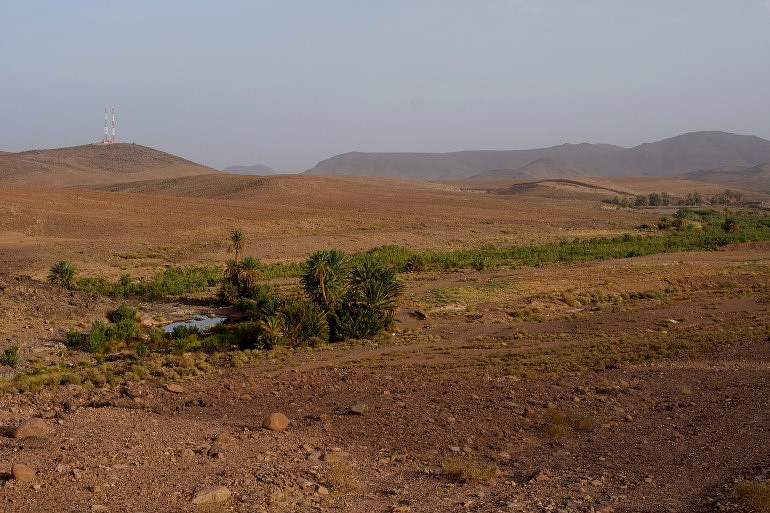
Dades Valley, Morocco – At the foot of the High Atlas mountain chain in southeastern Morocco, each village is named after the river that used to run through it. But today dry palm trees surround empty riverbeds and bridges now cross only stones left underneath. 💬 “When I was a child I used to swim in this river. There was an incredible fish diversity. Today half a century later, my wadi [valley] is completely dry,” says Yousef, a farmer from Kalaat MGouna, east of the gateway city of Ouarzazate. Yousef, a retired immigrant worker who lived in France, returned to his home village to grow olives, almonds, and pomegranate trees. Little did he know that irrigating his crops would become an impossible task. ● The Ouarzazate semi-desert region is drying out. As in the rest of North Africa, global warming is already showing its effects and badly affecting agriculture. In the context of drought, Moroccan farmers point the finger at the mismanagement of remaining water resources, which have been diverted from their natural course to be set aside for expanding industries. Three industries in southeastern Morocco consume the most water: mining companies, agricultural monocultures, and the world’s largest solar power plant, Noor, generating thermal energy through an evaporation process. Water from the valleys around Ouarzazate is collected in the al-Mansour Eddahbi dam which is below 12 percent of its current capacity. ● Environmental groups in the region have criticised its centralised and extractive resource management of the resource. 💬 “Local communities suffer from the effects of the climate crisis and do not even benefit from these large projects,” says Jamal Saddoq, a representative of Attac Morocco, one of the few associations working on the consequences of the extractive industry in the southeast. Along the roads through the desert, it is not uncommon to notice a white smoke cloud – a sign of mining activity. Excluding phosphates, about 40 percent of the mining licenses in Morocco are located in the Drâa-Tafilalet region. ● According to a recent interview with the Minister of Energy Transition and Sustainable Development Leila Benali, companies in Morocco produce three million tonnes of minerals per year. Managem group, a Moroccan company operating in the extraction of precious metals and cobalt, owns the main sites in the region. This is the case of the Imider mine, the largest in Africa, from where precious minerals such as silver leaves for Gulf and European countries. ● Demonstrators have been calling for an equitable distribution of resources, including water. “We got some achievements but not up to what we expected. About 50 young people have been hired and some development projects have been set up,” the activist said. 💬 “We have been protesting since the 1980s, but little has changed except that groundwater is running out. The company is still pumping water, digging wells deeper and deeper,” says one anti-mine activist, speaking on condition of anonymity to avoid repercussions from the authorities. “That’s why in 2011 we decided to block the pipeline connecting the mine to its water tank.” As the company’s own website explains, the mining industry needs water to recover precious metals from ore.
11/10/22
COP27: Countries band together to keep forest promise
More than 25 countries at the COP27 climate talks on Monday launched a group they said would ensure they hold one another accountable for a pledge to end deforestation by 2030, and announced billions of dollars to finance their efforts. | The first meeting of the Forest and Climate Leaders’ Partnershipis being chaired by Ghana and the United States. It takes place a year after more than 140 leaders promised at COP26 in Britain to end deforestation by the end of the decade. ● Progress since has been patchy, with only a few countries instituting more aggressive policies on deforestation and financing. The new group – which includes Japan, Pakistan, the Republic of Congo, and Britain – accounts for roughly 35 per cent of the world’s forests and aims to meet twice a year to track progress. Notable omissions from the group are Brazil, with its Amazon rainforest, and the Democratic Republic of Congo, whose vast forests are home to endangered wildlife including gorillas. ● Private cash piles up: Private companies announced US$3.6 billion in extra money. They include investment firm SouthBridge Group, creating a US$2 billion fund for restoration efforts in Africa, the region with the most tropical rainforest after South America. Volkswagen Group and H&M Group signed up to a separate initiative, The Leaf Coalition, launched at COP26, in which governments and companies pay countries with tropical and subtropical forests for emissions reductions.
11/07/22
Ukraine eclipses the sun: Europe's reparations will be done differently
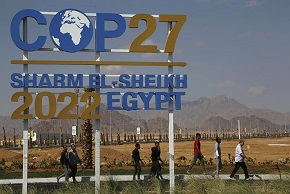
Elena Panina (Елена Панина) | "COP27 Talks Begin With Deal to Discuss Climate Reparations," reads a headline over at Bloomberg. That's a mouthful, but what's the substance? It turns out that at the 27th climate summit which opened in Egypt, rich countries agreed for the first time not to block a discussion (!) about compensation (!) to undeveloped countries for global warming damage. ● But before that there was a 48-hour haggle on the sidelines which ended with a "compromise": to focus not on the compensation itself, but on "cooperation and assistance". The decision is to be taken "no later than 2024". In other words, there will be no money. ● Just as no one has yet seen the promised $100 billion annually from developed countries "to save the climate. This is mere pennies compared, for example, to the $693bn the G20 countries spent on supporting the fossil fuel industry in the "herbivorous" year of 2021. ● Now, in a year of "record heat waves, droughts and floods," compounded by an energy crisis and the reopening of coal mines in Europe, old calculations about the energy transition are going in the bin. That is where they belong. After all, the grand scam of plundering money from the Old World "to repair the weather" is no longer very necessary. It has been overshadowed by the "Ukrainian crisis", which has brought and will continue to bring the beneficiaries far greater dividends. (www.DeepL.com/)(AP Photo/Thomas Hartwell)
COP27: Will Rich Nations Walk Their 'Loss and Damage' Talk or Sweep It Under Rug Again? (Sputnik News)
10/30/22
Winds of change...
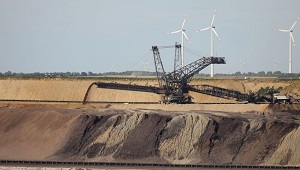
A bucket excavator removes top layers of soil and sand
from former farmland during expansion of the Garzweiler
II open-cast lignite coal mine. (A. Rentz/Getty Images)
White-fronted Magpie | Germany's national energy supplier has decided to dismantle a total of eight wind turbines in order to expand its lignite mining area. | These measures are reportedly taken to ensure the safety of these turbines, as mining operations in the Garzweiler near Erkelenz are planned until 2030. The federal and regional authorities have thus agreed together with the energy company RWE that the phase-out of coal mining in the mining region will be postponed until 2030. ● For years, climate activists have been fighting to prevent the destruction of homes in the area that could result from the expansion of mining. So amid the news, they are outraged and the Greens have criticised the plan, calling it "absurd to demolish wind turbines in the midst of a climate and energy crisis in order to redevelop a coal mine". ● The dismantling of wind turbines to expand the mine speaks volumes about the complete failure of European attempts to switch to green generation. In recent years the West has spent billions on this trendy environmental idea, and today for the sake of mining "dirty" lignite it is abandoning its plans along with abandoning the wind towers. And all in the name of saving an energy industry that is in a rude crisis. ● European states have failed to make their energy sectors independent of external sources, and have not learned to look into the future and foresee the consequences of their decisions not just for a year, but for more than a month. So today they are forced to scramble to find the means to deal with the energy crisis, forgetting the populist ideals of the past. (www.DeepL.com/)
:: Next >>