

Global Warming Fatigue Spreads

Doug L. Hoffman

In the run up to Copenhagen, global warming alarmists are spreading the word that climate change is progressing even faster than the IPCC has projected. But contradictory data from skeptics and open minded scientists continues to indicate that global warming has gone on hiatus and may not return for decades. This has sparked a noticeable drop in public concern over climate change and has led some climate change true believers to bemoan increasing public “Climate Fatigue.”

“We are basically looking now at a future climate that is beyond anything that we've considered seriously,” ecologist and IPCC author Christopher Field of Stanford University in Palo Alto, California, said in February at the annual meeting of the American Association for the Advancement of Science (AAAS). In March, a meeting of 2000 climate scientists in Copenhagen prompted the headline “Projections of Climate Change Go From Bad to Worse, Scientists Report.”


Witness To Palestine: The New Pharisees

Zahi / Political Theatrics

[Political Theatrics: This article was emailed to me by a reader of Palestinian descent, his background as well as his families background are noted in the following article. I believe it is a must read for any Christian supporter of Israel for it shows the plight of the Palestinian Christians we hear so little of.]

As Jesus had warned, ‘beware the leaven of the Pharisees, for it is hypocrisy. They come to you in sheep’s clothing, but inwardly they are ferocious wolves.

As within most families, children can generally sense if their parents are feeling anxious or uneasy, no matter how much parents try to hide their feelings, naturally, out of a protective instinct that any loving parents have for their children. Little usually needs to be said in order for children to sense any stress or emotional pain a parent may be experiencing at any particular moment. In my family, the triggers for an elevated level of anxiety often came from news reports about unfolding events in Palestine.


Death of a Lifestyle

Christopher Eastin

What is going to happen when the majority of Americans can not afford to drive to work let alone the grocery store? Will they sit quietly while they try to decide between the children getting feed or driving to work? They won’t sit quietly and the government knows it.

Dependence on Foreign Oil

In 2005 the United States consumed roughly 21 million barrels of oil daily compared to the global daily consumption of about 84 million barrels. Contrast these numbers with the 2002 daily statistics of 19 and 75 million barrels respectively. From 2002 to 2005 the United States oil production dropped from 8.1 to 5.1 million barrels per day, a production decrease of roughly 3 million barrels per day! Although we have approximately 20 billion barrels left under our feet this oil is of a lesser grade and much harder to pump thus driving the cost per barrel higher. Where does the rest of this oil come from and what will happen when that supply is no longer available?


An open letter from Dr. Judith Curry on climate science

Dr. Judith Curry

I asked Dr. Judith Curry if I could repost her letter which she originally sent to Climate Progress, here at WUWT. Here was her response:

From: Curry, Judith A
Sent: Friday, November 27, 2009 2:10 PM
To: Anthony Watts – mobile
Subject: Re: request

Hi Anthony, by all means post it. I am trying to reach out to everyone, pls help in this effort. Judy

Dr. Curry gets props from the skeptical community because she had the courage to invite Steve McIntyre to give a presentation at Georgia Tech, for which she took criticism. Her letter is insightful and addresses troubling issues. We can all learn something from it. – Anthony

~~~

An open letter to graduate students and young scientists in fields related to climate research – By Dr. Judith A. Curry, Georgia Tech

Based upon feedback that I’ve received from graduate students at Georgia Tech, I suspect that you are confused, troubled, or worried by what you have been reading about ClimateGate and the contents of the hacked CRU emails. After spending considerable time reading the hacked emails and other posts in the blogosphere, I wrote an essay that calls for greater transparency in climate data and other methods used in climate research. The essay is posted over at climateaudit.org (you can read it at http://camirror.wordpress.com/ 2009/ 11/ 22/ curry-on-the-credibility-of-climate-research/).


State of Denial: The ‘It-is-not-us’ syndrome

Hajrah Mumtaz

A couple of months ago, I wrote a column in praise of certain Pakistani pop stars and bands, arguing that there are a fair number of songs that display political consciousness and a related sense of responsibility. I referred to such songs as Junoon’s ‘Talaash’, Shahzad Roy’s ‘Lagay Raho’ and ‘Kismet Apnay Haath Main’, Noori’s ‘Merey Log’ and Laal’s rendition of Habib Jalib’s ‘Main Nay Uss Say Yeh Kaha.’

I find now that that argument was all very well – as far as it went. Such is the manner in which we are bound by our long-cherished prejudices and mental chains that it took a report by the New York Times’ Adam B. Ellick to show me what I had completely failed to notice: the music acts’ total refusal to either touch upon the topic of the Taliban, or to even acknowledge them as a concern.


Arrogancia en la clausura de la Cumbre Iberoamericana. El "rey" de España manda a callar a sus ex colonias americanas

redaccion@altercom.org

Jefe No Electo Democráticamente Del Estado Español Se Confronta Con Jefe Electo Democráticamente Del Estado Venezolano. [English version below]

Con una actuación sin precedentes, el llamado "soberano" de España, Juan Carlos de Borbón, visiblemente enojado por las críticas de Nicaragua, Argentina y Venezuela a sectores de ese país, intentó imponer su supuesta autoridad en la Cumbre Iberoamericana realizada en Chile, al irrespetar al mandatario venezolano mandándolo a callar, como recordando las épocas de sumisión de las colonias españolas en América, luego que éste respondía con hechos históricos la actuación del ex jefe de gobierno español en el golpe de estado del 2002.

El jefe de gobierno de España, José Luis Rodríguez Zapatero había reprochado a Chávez sus apreciaciones a Aznar, a lo que ha respondido el presidente venezolano apelando a su derecho a opinar, momento en el que la arrogancia imperial quiso acallar las críticas.

Juan Carlos de Borbón, rey de España -más no de Venezuela-, para nada acostumbrado a escuchar a alguien exigirle respeto, perdió los estribos y gritó: "¡¿Por qué no te callas?!", mientras, enojado, le señalaba con el dedo. La presidente chilena intentó calmar los ánimos y pedirles respetar los derechos de palabra a los mandatarios.


The Dog Ate Global Warming

Patrick J. Michaels

[This was published in National Review Online on September 23, 2009.]

Interpreting climate data can be hard enough. What if some key data have been fiddled?

Imagine if there were no reliable records of global surface temperature. Raucous policy debates such as cap-and-trade would have no scientific basis, Al Gore would at this point be little more than a historical footnote, and President Obama would not be spending this U.N. session talking up a (likely unattainable) international climate deal in Copenhagen in December.

Steel yourself for the new reality, because the data needed to verify the gloom-and-doom warming forecasts have disappeared.

Or so it seems. Apparently, they were either lost or purged from some discarded computer. Only a very few people know what really happened, and they aren’t talking much. And what little they are saying makes no sense.

In the early 1980s, with funding from the U.S. Department of Energy, scientists at the United Kingdom’s University of East Anglia established the Climatic Research Unit (CRU) to produce the world’s first comprehensive history of surface temperature. It’s known in the trade as the “Jones and Wigley” record for its authors, Phil Jones and Tom Wigley, and it served as the primary reference standard for the U.N. Intergovernmental Panel on Climate Change (IPCC) until 2007. It was this record that prompted the IPCC to claim a “discernible human influence on global climate.”


Two more elderly men die alone in Sydney

Mary Beadnell

[29 January 2008:] Two more lonely deaths in Sydney have shed further light on a disturbing social trend. Frail and aged, living alone, suffering from ill health and with few personal resources, increasing numbers of elderly working class people are being left to fend for themselves with little or no support, following years of government cuts to social welfare programs.

Residents of a public housing estate at Yagoona, in Sydney’s western suburbs, expressed outrage at the discovery of the badly decomposed body of their neighbour, Jorge Chambe-Coloma, a 64-year-old retired factory worker, on January 8. Chambe-Coloma, originally from Ecuador, had no family in Australia. He had worked as a process worker at the B&D Roller Door factory in nearby Revesby, until his retirement some years ago. It is believed Chambe-Coloma died more than 12 months earlier. Even though his electricity had been cut off for at least six months, the New South Wales Department of Housing took no action because his rent had continued to be paid by direct debit from his bank account.

When neighbours noticed his mailbox was overflowing, they alerted police, who made the grisly discovery.


US Violates Chemical Weapons Convention

Julian Assange & staff

"The use of chemical weapons by US forces was explicitly banned by President Gerald Ford in 1975 after CS gas had been repeatedly used in Vietnam to smoke out enemy soldiers and then kill them as they ran away. Britain would be in a particularly sensitive position if the US used the weapons as it drafted the convention and is still seen internationally as its most important guardian. The [UK] Foreign Office [Minister of State, Mike O'Brien] said: "All state parties to the Chemical Weapons Convention have undertaken not to use any toxic chemical or its precursor, including riot-control agents. This applies in any armed conflict." [1]US Prepares to Use Toxic Gases in Iraq, The Independent (London), March 2, 2003"

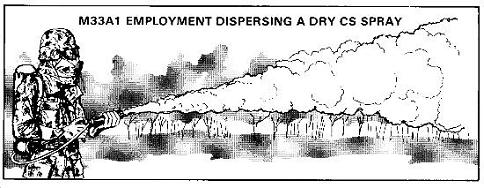
The United States has been caught with at least 2,386 chemical weapons deployed in Iraq. The items appear in a spectacular 2,000 page leak of nearly one million items of US military equipment deployed in Iraq given to the government transparency group Wikileaks. The items are labeled under the military's own NATO supply classification Chemical weapons and equipment.


Depleted Uranium – Far Worse Than 9/11

Doug Westerman

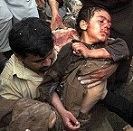
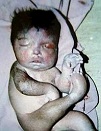
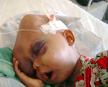
Photo: This child was born in Iraq in the years since the Gulf War, when over three hundred tons of highly toxic depleted uranium were fired in weapons at Iraq. While there is no direct evidence (or research for that matter) linking depleted uranium exposure with such birth defects, doctors in Iraq report a tenfold increase in certain kinds of birth defects (including webbed or fused fingers and toes, missing eyes and vital organs, and severe brain damage) since the end of the war--and many US Gulf War Veterans have parented children with similar birth defects. Picture courtesy of Campaign for Nuclear Disarmament's Campaign against Depleted Uranium.

Depleted Uranium Dust – Public Health Disaster For The People Of Iraq and Afghanistan

In 1979, depleted uranium (DU) particles escaped from the National Lead Industries factory near Albany, N.Y.,which was manufacturing DU weapons for the U.S military. The particles traveled 26 miles and were discovered in a laboratory filter by Dr. Leonard Dietz, a nuclear physicist. This discovery led to a shut down of the factory in 1980, for releasing morethan 0.85 pounds of DU dust into the atmosphere every month, and involved a cleanup of contaminated properties costing over 100 million dollars.

Imagine a far worse scenario. Terrorists acquire a million pounds of the deadly dust and scatter it in populated areas throughout the U.S. Hundreds of children report symptoms. Many acquire cancer and leukemia, suffering an early and painful death. Huge increases in severe birth defects are reported. Oncologists are overwhelmed. Soccer fields, sand lots and parks, traditional play areas for kids, are no longer safe. People lose their most basic freedom, the ability to go outside and safely breathe. Sounds worse than 9/11? Welcome to Iraq and Afghanistan.


Rumors Of Coups And War: U.S., NATO Target Latin America

Rick Rozoff

The United States are back in Latin America. The military coup in Honduras marked the beginning of Washington’s renewed grip on that continent. While another coup was thwarted in Paraguay, the United States, the United Kingdom and the Netherlands have been deploying new forces to encircle the ALBA countries with a view to attacking Nicaragua, Ecuador and Venezuela. Readying for the gathering storm, Chile has embraced the North-American camp and stockpiled a powerful arsenal.

November 28 will mark five months since the coup led by U.S.-trained commanders deposed the president of Honduras, the next day will see a mock election in the same nation designed to legitimize the junta of Roberto Micheletti, and the day following that will be a month since Washington signed an agreement with the Alvaro Uribe government in Colombia for the use of seven military bases in the country.


Dry Lands

Rebecca Solnit

Dead Pool: Lake Powell, Global Warming and the Future of Water in the West by James Lawrence Powell. California, 283 pp, £19.95, January 2010, ISBN 978 0 520 25477 0

The Colorado River no longer reaches the sea. Its dams and reservoirs are failing, silting up while the water level drops.

The supply of stories has perhaps been the American West’s only reliable bounty. The difficult thing has been finding people to notice them, let alone tell them well. The Indian wars, still unfinished as tribes continue to struggle for rights, territory and cultural survival; the resource rushes, the Gold Rush in particular, which turned San Francisco into a cosmopolitan city standing alone in the wilderness; the once astonishingly abundant salmon runs that sustained soil and trees, as well as birds, bears and humans; the timber wars; the rangeland wars; the radical labour and environmental movements; the attitudes people adopted towards a harsh, unfamiliar, often sublime landscape; the evolution of European cultures in a non-European terrain and the arrival of Asian and Latin American immigrants to shape a hybrid culture: all these have had their occasional historians, though most Americans were raised to believe that history happened somewhere else. The San Francisco Public Library has an overflowing case of books on the East’s Civil War, but only a handful on the war that transferred a million square miles or so of Mexico to the United States, including California and most of what we now call the West.


What You Should Know Before the Copenhagen Summit

Marco Villa

President Obama and the Democrat’s cap-and-trade plan would tax anyone who uses energy. Everytime you turn on your lights, you’ll be taxed.

The Eurocrats have themselves a new summit where world leaders will meet once again and engage in alarmist rhetoric about “global warming” and Big Governments will then purpose new tax and regulatory burdens on their citizens.

The Copenhagen Summit to take place in December will be Kyoto Redux - the failed European scheme to undermine American competitiveness under the rubric of environmental conscienceness.

Barack Obama had intended to have Congress pass his cap-and-trade tax bureaucracy before heading to Denmark so he could pander to European socialists. But, alas, only the House of Representatives has passed this new massive tax bureaucracy and the Senate will not even start debating it until next year.

You’ll hear a lot of Al Goresque fear mongering in the days leading to and during Copenhagen, but here’s what you should know before you make up your mind about “global warming” and whether we need Big Government to tax and regulate our lives even more:


Freedom & Life: Of Turkeys & Men by Sibel Edmonds + Bagram Prison Exposed

Sibel Edmonds

Dear Mr. President:

Today is the official Presidential Turkey Pardon Day for 2009, your very first since taking office. I understand you are planning to fly your pardoned bird(s) First Class to California, where they will live at Big Thunder Ranch at Disneyland. How lucky are these birds, how kind of you to value their lives and freedom, and how generous of you to release them.

Mr. President, there are many innocent human beings who have been caged for over six years, under deplorable conditions, including torture – despite being innocent and having done nothing wrong. Their last ten months of detainment and torture have taken place under your watch, per your orders, and with your instructions.


Climategate: Shutting out dissent

John McLean

By now everyone, except perhaps the readers of some of the mainstream press, knows that about 4,500 files from the UK's Climatic Research Unit (CRU) at the University of East Anglia (UEA) found their way onto the world wide web last Friday.

It was first suggested that this was the work of a hacker but that's shifted to a whistleblower within the CRU. It has also been speculated that the files, bundled into a single zip file of 61Mb, were in response to a request under the Freedom of Information Act (FOIA). Personally I wonder if this is true, but not to respond to the request, rather to move the files to another machine for "safe keeping" from prying eyes. This would be consistent with the attitudes to FOI requests expressed in the leaked emails, moreover when moving them to another CRU machine the accidental insertion of a full stop between the C and R in CRU would produce ".ru", the Internet code for Russia, which was where these files initially appeared on the Internet.


Stagnating Temperatures: Climatologists Baffled by Global Warming Time-Out

Gerald Traufetter

"We have to explain to the public that greenhouse gases will not cause temperatures to keep rising from one record temperature to the next, but that they are still subject to natural fluctuations." -Climatologist Mojib Latif.

Part 1: Climatologists Baffled by Global Warming Time-Out

Global warming appears to have stalled. Climatologists are puzzled as to why average global temperatures have stopped rising over the last 10 years. Some attribute the trend to a lack of sunspots, while others explain it through ocean currents.

At least the weather in Copenhagen is likely to be cooperating. The Danish Meteorological Institute predicts that temperatures in December, when the city will host the United Nations Climate Change Conference, will be one degree above the long-term average.

Otherwise, however, not much is happening with global warming at the moment. The Earth's average temperatures have stopped climbing since the beginning of the millennium, and it even looks as though global warming could come to a standstill this year.

Ironically, climate change appears to have stalled in the run-up to the upcoming world summit in the Danish capital, where thousands of politicians, bureaucrats, scientists, business leaders and environmental activists plan to negotiate a reduction in greenhouse gas emissions. Billions of euros are at stake in the negotiations.


3,000 Behavior Detection Officers Will Be Watching You at the Airport -Feeling Nervous?

Liliana Segura

Nearly 100,000 passengers were pulled aside by TSA behavior watchers last year, and it remains to be proven whether you can spot terrorists by the looks on their faces.

Here's a question to ponder the next time you're taking off your shoes at airport security: Can you spot terrorists by the look on their faces?

For the Transportation Security Administration (TSA), the answer is yes. For the past few years, airports across the country have been using what many call "behavioral surveillance" to weed out potential hijackers among us, by covertly examining travelers' facial expressions and body language as they go through security. Unlike those airport employees who herd us along as we remove our shoes and relinquish all liquids over three ounces (with dubious results), this new program, named "Screening Passengers by Observational Techniques," or "SPOT," is carried out by TSA employees who have been trained to monitor travelers' faces and movements. As Americans head out of town this holiday season, more than 3,000 "Behavior Detection Officers" will be at 161 airports nationwide, watching our every move.


Stop the lama love-in

Andy Lamey

He’s adorable, yes, but just what is the Dalai Lama accomplishing?

Everyone loves the Dalai Lama. Just how much was on display two weeks ago when the Tibetan religious leader paid a visit to the town of Tawang in northeastern India. Ethnic Tibetans travelled to the frontier outpost from all over the sub-continent in order to venerate the 74-year-old monk at a huge outdoor rally. “He is our god, he is the living Buddha. A glimpse of the Dalai Lama is like getting spiritual power inside you,” said one participant in explaining the extraordinary adulation the Dalai Lama inspires. Here in Canada, our view is not so different. When the Dalai Lama travelled to Vancouver, Calgary and Montreal last month, tens of thousands crowded into stadiums to hear his message of universal compassion. The rapturous reception was in keeping with our decision in 2006 to grant him citizenship, the highest honour Canada bestows on foreign leaders. The Dalai Lama’s other admirers include the U.S. government, which awarded him the Congressional Gold Medal, and the Nobel Peace Prize committee. The general feeling of Lama-mania was summed up by TV star Sandra Oh, who co-hosted one of his Canadian appearances. “He’s a rock star! Rock star! Seriously, a rock star!”


World Bank Secret Report confirms Biofuel Cause of World Food Crisis

F. William Engdahl

A secret study by the World Bank, which reportedly has not been made public on pressure from the Bush Administration, concludes that bio-fuel cultivation in especially the USA and EU are directly responsible for the current explosion in grain and food prices worldwide. The US Government at the recent Rome UN Food Summit claimed that "only 3% of food prices" were due to bio-fuels. The World Bank secret report says that at least 75% of the recent price rises are due to land being removed from agriculture —mainly maize in North America and rapeseed and corn in the EU— in order to grow crops to be burned for vehicle fuel. The World Bank study confirms what we wrote more than a year ago about the madness of bio-fuels. It fits the agenda described in the 1970’s by Henry Kissinger, namely, ‘If you control the food you control the people.’


The science of deceit

Bob Carter

Science is about simplicity

A well-accepted aphorism about science, in the context of difference of opinion between two points of view, is “Madam, you are entitled to your own interpretation, but not to your own facts”.

The world stoker of the fires of global warming alarmism, the United Nations Intergovernmental Panel on Climate Change (IPCC), cleverly suborns this dictum in two ways.

First, the IPCC accepts advice from influential groups of scientists who treat the data that underpins their published climate interpretations (collected, of course, using public research funds) as their own private property, and refuse to release it to other scientists.

Thus, confronted in 1996 with a request that he provide a U.S. peer-review referee with a copy of the data that underpinned a research paper that he had submitted, U.K. Hadley Climate Research Centre scientist Tom Wigley responded:


Culling the Herd

Sheila Samples

"Depopulation should be the highest priority of foreign policy towards the third world, because the US economy will require large and increasing amounts of minerals from abroad, especially from less developed countries.” ~~Henry Kissinger

"Everything you can imagine is real" ~~Pablo Picasso

In 1974, a year after orchestrating a mass terror bombing of Cambodia -- after being awarded the Nobel Peace Prize -- Secretary of State Henry Kissinger and his National Security Council completed “National Security Study Memo 200: Implications of Worldwide Population Growth for U.S. Security and Overseas Interests.” This document, whose sharp edges are dulled by page after leaden page of how to reduce over-population in the Third World through birth control and "other" population-reduction programs, was classified until 1989, but was almost immediately accepted as US policy, and remains the US blueprint for ethnic cleansing today.


Consequences of a forced regime change in Iran

Dr. Abbas Bakhtiar


This is Iran, the next country israel wants the US to destroy.

“Give me the money that has been spent in war and I will clothe every man, woman, and child in an attire of which kings and queens will be proud. I will build a schoolhouse in every valley over the whole earth. I will crown every hillside with a place of worship consecrated to peace.” (Charles Sumner).

In each war there are always winners and losers. The winners are those who make money and gather more power to themselves while all the others are the losers. It doesn’t matter if one has been on this side or that side; chances are that in the end the majority end up losing far more than they thought they will gain. Ask any parent that has lost a child in a war if he or she can in any way be compensated for that loss and you’ll have the answer. ―One can expect the push for war from those who will gain from it, but not from those who lose. But the sad fact is that those who gain from war use all the communication means at their disposal to persuade the losers to support and even participate in the war. The American people were thus persuaded to participate in the war against Iraq. Those who were against it were labelled as unpatriotic fools who were working against their country’s interests.


Humiliation Experienced by Somali Refugees in Norway

Katrine Fangen


© Ressurssider om Norge og Somalia.

Abstract

Life as a refugee attempting to create a new life in an unfamiliar country is filled with uncertainties. Due to a lack of language and cultural knowledge, misunderstandings occur. People in these circumstances are vulnerable to experiences of humiliation. The majority population's prejudices against strangers also contribute to newly-arrived refugees experiencing more humiliating situations than do others. This paper attempts to analyse experiences of humiliation among refugees, using Somali refugees as a case. The principal research question here is why and how refugees experience humiliation in exile. What kinds of situations trigger feelings of humiliation in refugees and why are these situations experienced as humiliating?


The Palestinian Struggle and the Lakota Nation's secession from the USA

Dr John C K Daly / Andrew Winkler

On the Lakota Nation's secession from the USA: In today's email I received a fascinating article from La Voz de Aztlan on the recent declaration of secession from the USA by the Lakota Nation.

The Native American Lakota Sioux tribe has declared independence from the US unilaterally, citing a string of broken treaties dating back to the 19th century.

In the wake of 9/11, the Bush administration declared a dual global campaign, a war against terror and a US-led effort to promote democracy around the world. To use the CIA's term "blowback" for unintended consequences, the latter campaign has resonated within the US, with secessionist movements agitating for the values that Washington proclaims abroad: from American Indians through secessionist movements in the two most recent states added to the Union, Alaska and Hawaii, all the way to one of the original 13 Colonies, Vermont.

While the efforts have been largely ignored or ridiculed by the mainstream press, because of the Internet and the evolving global communications network, their causes have attracted immense interest abroad.


If you've done nothing wrong, you have everything to worry about

Pete McMartin

Whenever someone frets about the erosion of personal freedoms in our modern society, such as in the steady proliferation of surveillance cameras in public places, the stock answer, which is one I read all too often in my e-mail, is:

"If you haven't done anything wrong, you have nothing to worry about."

People who say this are fools, not to be too blunt about it. Not only are they willing to trade away my rights, since they haven't a basic appreciation of theirs, but their understanding of the relationship between government and the governed is one of subservience based on fear, and the idea that their fear is not only natural, but justifiably permanent given the state of the world.

Thus, we should all be fearful, all of the time. We should empower government to do whatever it feels necessary to protect us. The unquestioning nature of this logic not only institutionalizes fear, it makes it a patriotic duty. And the good citizen, the one who has done nothing wrong, will have nothing to worry about. -Oh, yeah?


A Report on the Size and Distribution of the World's Muslim Population

Pew Forum Executive Summary

Pew Forum Executive Summary.

A comprehensive demographic study of more than 200 countries finds that there are 1.57 billion Muslims of all ages living in the world today, representing 23% of an estimated 2009 world population of 6.8 billion.

While Muslims are found on all five inhabited continents, more than 60% of the global Muslim population is in Asia and about 20% is in the Middle East and North Africa. However, the Middle East-North Africa region has the highest percentage of Muslim-majority countries. Indeed, more than half of the 20 countries and territories [1] in that region have populations that are approximately 95% Muslim or greater.

More than 300 million Muslims, or one-fifth of the world's Muslim population, live in countries where Islam is not the majority religion. These minority Muslim populations are often quite large. India, for example, has the third-largest population of Muslims worldwide. China has more Muslims than Syria, while Russia is home to more Muslims than Jordan and Libya combined.


The Pot Calls The Kettle Black

Eric S. Margolis

President Karzai will of course establish an anti-corruption commission. Some big turbans will be prosecuted to please Washington. But this charade will fool no one but US voters.

Not so long ago, Hamid Karzai, the US-installed president of Afghanistan, used to be hailed by Washington and the US media as a noble democrat and statesman.

But as things in Afghanistan went from bad to worse, and Taliban gained strength and popularity, Washington directed its ire at Karzai, who had almost no power of his own and was forced to rely on the US, the Tajik-Uzbek-Communist Northern Alliance, and assorted drug-dealing warlords. After some of Karzai’s henchmen become over-zealous in rigging Afghanistan’s last already rigged election, Washington exploded in anger and frustration, blaming its wayward puppet for the growing mess in the Hindu Kush.


On the credibility of climate research

Judy Curry

Having been riveted for the last few days by posts in the blogosphere on the HADCRU hack and the increasing attention being given to this by the mainstream media, I would like to provide an “external but insider” assessment and perspective. My perspective is as a climate researcher that is not involved directly in any of the controversies and issues in the purloined HADCRU emails, but as one that is familiar with this research, the surrounding controversies, and many of the individuals who sent these emails. While the blogosphere has identified many emails that allegedly indicate malfeasance, clarifications especially from Gavin Schmidt have been very helpful in providing explanations and the appropriate context for these emails. However, even if the hacked emails from HADCRU end up to be much ado about nothing in the context of any actual misfeasance that impacts the climate data records, the damage to the public credibility of climate research is likely to be significant. In my opinion, there are two broader issues raised by these emails that are impeding the public credibility of climate research: lack of transparency in climate data, and “tribalism” in some segments of the climate research community that is impeding peer review and the assessment process.


Cooking the History Books: The Thanksgiving Massacre

Laura Elliff, Vice President, Native American Student Association

Is All That Turkey and Stuffing a Celebration of Genocide?

Thanksgiving is a holiday where families gather to share stories, football games are watched on television and a big feast is served. It is also the time of the month when people talk about Native Americans. But does one ever wonder why we celebrate this national holiday? Why does everyone give thanks?


Corn-to-Ethanol: US Agribusiness Magic Path To A World Food Monopoly

Charles E. Carlson

Eight years of Biofuels (ethanol) policy and legislation has cemented in place the first world wide food cabal, which promises a humanitarian disaster, a famine more serious than those caused by any tsunami, earthquake or drought. This crisis is not in the dim future, it is here.

Congress has, in a series of acts passed in this millennium, handed the perfect monopoly to what appears to be few giant agribusiness companies that already have enormous economic power, but which may be a much broader cabal.

If you can afford $6.00 a gallon for milk, $4.00 for a loaf of bread and still have money left over for a $50.00 steak at Outback, you may be prepared for 2008, but what about the future? Even if you and I may think we are prepared financially to buy food, whatever the cost, we must have concern for the billion souls who are not and who are condemned to starvation by the corn-to-alcohol conversion scheme.

Subsidies do not make the giant agribusiness firms criminals, only opportunists. Their Public Relations distortion about the value of grain alcohol as fuel is criminal. Congressmen are the real cheats, for they could acknowledge this if they wanted to, but they do not, so they share in the crimes—grand theft and murder by starvation. This being a “Christian” society, it falls to those who heed Jesus Christ’s repeated admonitions to feed the needy and protect those who cannot protect themselves to stop corn-to-alcohol conversion. Make no mistake this is a moral issue.


Apaches Defend Homeland from Homeland Security

Brenda Norrell

[Rio Grande, Albuquerque. This photo shows the shore of the Rio Grande in Albuquerque. You see a sampling of the appealing fall colors as trees prepare for winter in the bosque. The Manzano mountain range can be seen in the background. This is as seen from the Central Avenue Overpass near the Rio Grande Botanic Garden. This was shot at aproximately 4:45 in the evening in early November, 2005.]

Apache land owners on the Rio Grande told Homeland Security to halt the seizure of their lands for the US/Mexico border wall on January 7, 2008. It was the same day that a 30-day notice from Homeland Security expired with the threat of land seizures by eminent domain to build the US/Mexico border wall.

"There are two kinds of people in this world, those who build walls and those who build bridges," said Enrique Madrid, Jumano Apache community member, land owner in Redford and archaeological steward for the Texas Historical Commission.

"The wall in South Texas is militarization," Madrid said of the planned escalation of militarization with Border Patrol and soldiers. "They will be armed and shoot to kill."


Wounded over ‘Bury My Heart’

Joe Orso

Like a wise man told me, it’s important to remember that native people’s history is not all dates and wars and tragedy. It contains a rich cultural and spiritual story that continues to speak. But to hear the full boom of those voices, we must look back, be silent and reflect on the devastation committed here not so long ago.

I once knew an Iraqi man who first learned of the Holocaust when he was an adult, traveling in Israel.

It was shocking to think that anyone on earth might not know this story, and the experience gave me a deeper appreciation for the power of education — and miseducation.

But while that was disturbing, I have been even more disturbed to find myself in the same position as the Iraqi man this past month.

Of course I’d learned something about Native American history growing up, and had a vague sense of tragedies and broken treaties. But it was not until reading “Bury My Heart at Wounded Knee” that I saw the enormity of the genocide that happened on this continent — an enormity on par with the tragedies of German history.


A wall to keep out Roma

Michaela Stanková

Tensions between the mainly Roma inhabitants of a settlement next to the village of Ostrovany, near Šarišské Michaľany in eastern Slovakia, and the village’s mainly non-Roma population now have a physical embodiment: a wall that the local authorities agreed to build in order to separate the settlement from the rest of the village. While non-Roma villagers claim the wall is the only way to prevent raids on their fruit gardens from the Roma settlement, local Roma protest that the wall has turned their settlement into a zoo.

Šarišské Michaľany recently became a symbol of the problems between the Roma minority and the non-Roma majority in Slovakia. Last year an inhabitant of the Roma settlement murdered a shop assistant in the village and this summer two boys from the settlement assaulted a 65-year old man who lost an eye and suffered other injuries in the attack. In response to the attack a far-right group, Slovenská Pospolitosť, used the village as the venue for the first of several protests which it organised to oppose what it called ‘the gypsy terror’ in eastern Slovakia.


'Liberation was just a big lie'

Olivia Ward


Malalai Joya, who was in Toronto to promote
her book, A Woman Among Warlords, says
Canada and the United States should pull their
troops out of Afghanistan as soon as possible.
(Nov. 18, 2009) Carlos Osorio/Toronto Star

Outspoken Afghan MP says Canadian mission is a big waste of time.

She sleeps in safe houses, with a rotating squad of bodyguards securing the doors. She goes out only in a billowing burqa. Even her wedding was held in secret.

Elected the youngest member of the Afghan parliament – and suspended for her outspoken criticism of the country's top officials – Malalai Joya has been labelled the bravest woman in Afghanistan.

Small, soft-spoken and now 31, she has survived at least four assassination attempts and is angry at the oppressive life she is forced to lead, dodging enemies she has denounced as bloody-handed warlords and drug kingpins.

As Afghan President Hamid Karzai is inaugurated Thursday for another four years in office after a fiercely disputed election, she says his term is already tainted by the corruption, criminality and violence of those around him. "(Prime Minister) Stephen Harper says this election was a success," she said. "But Karzai has not only insulted, but betrayed the Afghan people."

Karzai has vowed to launch anti-corruption investigations under pressure from Washington. But, Joya insists, Canada is wasting blood and treasure on keeping his government in power.


Black Elk Speaks -Part II

Black Elk
As told to John G. Neihardt

Chapter 14 :: The Horse Dance

There was a man by the name of Bear Sings, and he was very old and wise. So Black Road asked him to help, and he did.

First they sent a crier around in the morning who told the people to camp in a circle at a certain place a little way up the Tongue from where the soldiers were. They did this, and in the middle of the circle Bear Sings and Black Road set up a sacred tepee of bison hide, and on it they painted pictures from my vision. On the west side they painted a bow and a cup of water; on the north, white geese and the herb; on the east, the daybreak star and the pipe; on the south, the flowering stick and the nation's hoop. Also, they painted horses, elk, and bison. Then over the door of the sacred tepee, they painted the flaming rainbow. It took them all day to do this, and it was beautiful.

They told me I must not eat anything until the horse dance was over, and I had to purify himself in a sweat lodge with sage spread on the floor of it, and afterwards I had to wipe myself dry with sage.

That evening Black Road and Bear Sings told me to come to the painted tepee. We were in there alone, and nobody dared come near us to listen. They asked me if I had heard any songs in my vision, and if I had I must teach the songs to them. So I sang to them all the songs that I had heard in my vision, and it took most of the night to teach these songs to them. While we were in there singing, we could hear low thunder rumbling all over the village outside, and we knew the thunder beings were glad and had come to help us.

Pages: 1 · 2 · 3 · 4


Black Elk Speaks -Part I

Black Elk
As told to John G. Neihardt

In the summer of 1930, as part of his research into the Native American perspective on the Ghost Dance movement, Neihardt contacted an Oglala holy man named Black Elk, who had been present as a young man at the 1876 Battle of the Little Big Horn and the 1890 Wounded Knee Massacre. As Neihardt tells the story, Black Elk gave him the gift of his life's narrative, including the visions he had had and some of the Oglala rituals he had performed. The two men developed a close friendship. The book Black Elk Speaks, grew from their conversations continuing in the spring of 1931, and is now Neihardt's most familiar work. The current popularity of the book shows the growth of interest in the social and ethical analysis of Native American tribes.

Chapter 01 :: The Offering of the Pipe

My friend, I am going to tell you the story of my life, as you wish; and if it were only the story of my life I think I would not tell it; for what is one man that he should make much of his winters, even when they bend him like a heavy snow? So many other men have lived and shall live that story, to be grass upon the hills.

It is the story of all life that is holy and is good to tell, and of us two-leggeds sharing in it with the four-leggeds and the wings of the air and all green things; for these are children of one mother and their father is one Spirit.

This, then, is not the tale of a great hunter or of a great warrior, or of a great traveler, although I have made much meat in my time and fought for my people both as boy and man, and have gone far and seen strange lands and men. So also have many others done, and better than I. These things I shall remember by the way, and often they may seem to be the very tale itself, as when I was living them in happiness and sorrow. But now that I can see it all as from a lonely hilltop, I know it was the story of a mighty vision given to a man too weak to use it; of a holy tree that should have flourished in a people's heart with flowers and singing birds, and now is withered; and of a people's dream that died in bloody snow.

But if the vision was true and mighty, as I know, it is true and mighty yet; for such things are of the spirit, and it is in the darkness of their eyes that men get lost.

Pages: 1 · 2 · 3 · 4


Out of Sight, Out of Mind

Thunder Horse

Hidden away, out of sight but dotting the landscape of America, are the little known or forgotten Reservations of the Indigenous People of our land. Sadly, the average U.S. mainstream resident knows almost nothing about the people of the Native American reservations other than what romanticized or caricaturisation versions they see on film

or as the print media stereotypes of oil or casino-rich Indians. Most assume that whatever poverty exists on a reservation is most certainly comparable to that which they might experience themselves. Further, they assume it is curable by the same means they would use. But that is the arrogance of ignorance.

Our dominant society is accustomed to being exposed to poverty. It’s nearly invisible because it is everywhere.

We drive through our cities with a blind eye, numb to the suffering on the streets, or we shake our heads and turn away, assuming help is on the way. After all, it’s known that the government and the big charities are helping the needy in nearly every corner of the world.

But the question begs: What about the sovereign nations on America’s own soil, within this country, a part and yet apart from mainstream society? What about these Reservations that few people ever see?


The Gaza Chronicles: Part 3 - Shattered Minds And The Children of Gaza

Aditya Ganapathiraju


More than 95% children in Gaza experienced artillery shel-
ling in their area or sonic booms of low flying jets.

The Gaza Chronicles: Part 1- "The Forgotten Story"
The Gaza Chronicles: Part 2 - What a Siege Looks Like

It’s the most terrifying place I’ve ever been in… it’s a horrifyingly sad place because of the desperation and misery of the way people live. I was unprepared for camps that are much worse than anything I saw in South Africa.– Professor Edward Said 1993 [1]

They may be living but they’re not alive. – Journalist Philip Rizk [2]

Gaza is a place that needs a million psychologists.— Ayed, a psychotherapist from Northern Gaza [3]

Over 40 years of Israeli military occupation have had a devastating effect on Gaza; airstrikes, artillery shelling, ground invasions, jet flybys and their sonic booms have all led to an epidemic of suffering among Gaza’s most vulnerable inhabitants.[4]

Soon after the recent winter Israeli assault, a group of scholars at the University of Washington discussed different aspects of the situation in Gaza and the occupied Palestinian Territories. Dr. Evan Kanter, UW school of medicine professor and the current president of Physicians for Social Responsibility, delivered a somber talk describing the mental health situation among Gaza’s population.[5]

Dr. Kanter cited studies that revealed 62 % of Gaza’s inhabitants reported having a family member injured or killed, 67% saw injured or dead strangers and 83% had witnessed shootings. In a study of high school aged children from southern refugee camps in Rafah and Kahn Younis, 69% of the children showed symptoms of Post Traumatic Stress (PTS), 40% showed signs of moderate or severe depression, and a whopping 95% exhibited severe anxiety. Seventy percent showed limited or no ability to cope with their trauma. All of this was before the last Israeli invasion.


The Gaza Chronicles: Part 2 - What a Siege Looks Like

Aditya Ganapathiraju


Deterioration of Sanitation and Water Utilities:twenty million gallons of raw
and untreated sewage has to be dumped into the Mediterranean every day, ac-
cording to local officials. Photo: Electronic Intifada

The Gaza Chronicles: Part 1- "The Forgotten Story"
The Gaza Chronicles: Part 3 - Shattered Minds And The Children of Gaza

“Gaza is an example of a society that has been deliberately reduced to a state of abject destitution,” Sara Roy wrote in July. It has led to “mass suffering, created largely by Israel,” and aided by the active participation of the United States, European Union, and Palestinian Authority in the West Bank. [1]

The Israeli policy of isolating Gaza from the West Bank has been a gradual process that started in the early 1990s. It tightened soon after Hamas’ electoral victory in 2006, and turned even more devastating after Hamas’s 2007 takeover, degrading the society to the point where 96 percent of Gaza’s population of 1.5 million is dependent on humanitarian aid for basic survival. [2]

This “perverse” situation is unique in international affairs in that humanitarian groups are sustaining the Israeli occupation by providing care for a civilian population and territory whose humanitarian needs and economy are being deliberately decimated for political reasons, with full backing of the Israeli High Court, Roy explained. [3]


The Gaza Chronicles: Part 1 -"The Forgotten Story"

Aditya Ganapathiraju

The Gaza Chronicles: Part 2 - What a Siege Looks Like
The Gaza Chronicles: Part 3 - Shattered Minds And The Children of Gaza

Why are people on Gaza so unhappy? Well, if you had to live in a prison, wouldn’t you be unhappy? — Former CIA officer Robert Baer[1]

It’s the most terrifying place I’ve ever been in… it’s a horrifyingly sad place because of the desperation and misery of the way people live. I was unprepared for camps that are much worse than anything I saw in South Africa. – Professor Edward Said 1993[2]

They may be living but they’re not alive. – Journalist Philip Rizk[3]

The situation on the ground in Gaza has continued to deteriorate since January. One of the most densely populated areas in the world, this small coastal strip is home to a million and a half Palestinians, many of them refugees for over 60 years. It is now the worst condition it’s been in since 1967 when the Israeli army took military control of the land.[4]


How Television Controls And Programs Minds

L. Wolfe

Turn Off Your Television

Read this powerful indictment of uncontrolled TV viewing written in the early 1990s and then take stock of how much the Boob Tube is on in your own home. Its message is even more important today with TVs blaring in airports, bars, even offices. It is time to try Mr. Wolfe's therapy:

"Do you want to stay stupid and let your country go to hell in a basket? Why don't you just walk over to the set and turn it off. That's right, completely off. Go on, you can do it. Now isn't that better? Don't you feel a little better already? You've just taken the first step in deprogramming yourself. It wasn't that hard, was it? Until we speak again, try to keep it off. Now that will be a bit harder."
-Jim Marrs

The subconscious is powerful. It is aware of every particle and detail around you. But it doesn't know the difference between fact or fiction and acts on all information passing through the conscious mind as fact, and responds to it. So what do you think happens when you watch silly, moron, goofy commercials and television programs? They are training your thought processes. -Hey buddy, I'm talking to you. Yes, you, the guy sitting in front of the television. Turn down the sound a bit, so that you can hear what I am saying. Now, try to concentrate on what I am going to say. I want to talk to you about your favorite pastime. No, it's not baseball or football, although it does have something to do with your interest in spectator sports. I'm talking about what you were just doing: watching television.


U.S. nuclear arms in Japan: a firsthand account

Brian A. Victoria

Is it right for the lives of Japanese civilians near U.S. military bases to be held hostage to U.S. military activities on the Korean Peninsula?

Dear Prime Minister Yukio Hatoyama,

In the fall of 1980 I was assigned as a civilian university professor to provide Japanese language instruction to the officers and men of the USS Knox (FF-1052), a destroyer home-ported in Yokosuka. Sharing quarters with the ship's nuclear weapons officer, I soon became aware that the Knox was outfitted with an ASROC antisubmarine missile system including nuclear depth bombs.

I say this because: 1) The operations manual for these nuclear weapons lay in plain sight on the floor beneath the officer's desk; 2) receipts for the nuclear weapons first loaded on the ship in Guam were on his desk; and 3) an armed marine stood guard 24 hours a day in front of a door on the ship marked with a radiation hazard sign.


Psychological impact of disasters on children

Zain Ul Abideen

A disaster is the tragedy of a natural or human made hazard (a hazard is a situation which poses a level of threat to life, health property or environment) that negatively affects society or environment. But, disasters in whatever intensity took place, affected psychologically nearly each and every person of the country and children due to their vulnerability were and yet until now are worst victims of these disasters. Children are mostly susceptible to disaster suffering, and it is noticeable in many complex psychological and behavioral symptoms. On the other hand, sometimes the post-disaster psychological effects in children are not recognized. Sometimes parents, teachers and other concerned persons underestimate not only the intensity but the extent of the stress reactions in children. As children are expected to have different level of emotional maturity, very limited coping strategies based on their age, that’s why psychological responses in children are different from those in adults. Methods of intervention for children following disasters reasonably differ from adults.


Responding to Carol Miller's Op-Ed Criticizing Health Care Reform

Tyler Taylor

This is a guest blog by Tyler Taylor, M.D., who has a solo, patient-focused medical practice in Los Alamos, New Mexico. The piece was written in response to Sunday's op-ed in the Albuquerque Journal North by Carol Miller.

As a member of Physicians for a National Health Plan for over five years, and an enthusiastic Obama supporter, I find Carol Miller's op-ed in the Albuquerque Journal disturbing. When people on the right misrepresent the facts, all of my capacity for surprise has been exhausted. It's more upsetting though when my progressive kin seem to be doing that.

I disagree with several of Carol Miller's main points. For example, there is much more in this bill than "health insurance reform." It also is not accurate to say that the "reference benefit package" will include fewer services than most insured people have today, since the commission that will decide that won't even be created till this bill is passed. I fully agree that waiting till 2013 for most of this bill to take effect is unacceptable, but assuming that's a cynical political ploy by Obama seems unjustified. Is it not more likely this was one of many compromises needed to get some Blue Dog support?


We Need Health Care, Not Insurance

Carol Miller

Imagine real reform, as simple as adding people ages 55 to 65 years old to Medicare in 2010, 35-55 in 2011, and so on until everyone is included by 2013. The bills that promote this kind of reform are under 200 pages, they are simple to implement, cost effective and equitable. Choose a doctor, choose a hospital when needed and let the government pay the bills. Everyone in one system. That is what real health reform would look like.

A very complex, mandatory private insurance scheme recently passed the U.S. House. The public is being overwhelmed by sound bites on one hand about how great it is, on the other, how terrible. We are hearing few of the details that are actually in the bill. Having read the bill, it is clear now that what started as health reform has emerged from the political process as health "deform," building on the worst, not the best of the current system.


The Heyoka -Living Life Backwards

Todd F. Eklof


Illustration: David Michael Kennedy

“Why did it all turn out for me like this?” George asks, after an afternoon of self-reflection at the beach. “I had so much promise. I was personable, I was bright. Oh, maybe not academically speaking, but ... I was perceptive. I always know when someone's uncomfortable at a party. It all became very clear to me sitting out there today, that every decision I've ever made, in my entire life, has been wrong. My life is the complete opposite of everything I want it to be. Every instinct I have, in every aspect of life, be it something to wear, something to eat ... It's all been wrong.” Just then a waitress arrives to take his order.

At first he asks for the usual, tuna on toast, coleslaw and a cup of coffee. But then, in a moment of inspiration, he changes his mind. “Wait a minute,” he says, “I always have tuna on toast. Nothing’s ever worked out for me with tuna on toast. I want the complete opposite of tuna on toast. Chicken salad, on rye, untoasted ... and a cup of tea.” Although Jerry argues that salmon is actually the opposite of tuna since salmon swims against the current and tuna swims with it, George’s new lunch choice marks a bold step toward transforming his life.


Stærk lobbyisme bag WHO-beslutning om massevaccination

Louise Voller & Kristian Villesen


Kinesiske mødre med deres børn på en hospital i Hefei i Kina, hvor de bliver behandlet
for svineinfluenza. De kinesiske myndigheder er for tiden i færd med at vaccinere en stor
del af befolkningen i kampen mod svineinfluenzaen. Foto: AFP/Scanpix

Flere af WHO's influenzarådgivere er betalt af medicinalindustrien. Dermed var industrien med til at påvirke beslutningen om, at influenza A er en pandemi - og at vaccine er nødvendig. Siden har de samme virksomheder fået vaccineordrer for op mod 55 milliarder kroner.

Den 11. juni 2009 erklærede WHO’s generaldirektør, Margaret Chan, svineinfluenza for en pandemi. Det betød en kæmpe økonomisk gevinst for medicinalindustrien. Mange medlemslande - herunder Danmark - har nemlig kontrakter med de store medicinalvirksomheder og er derfor forpligtet til at købe vacciner i tilfælde af en pandemi.

Investeringsbanken JP Morgan vurderer, at medicinalindustrien i år vil modtage vaccineordrer for op imod 55 milliarder kroner. En stor del af den omsætning skyldes WHO’s beslutning. Mange af de tilsyneladende uvildige forskere, som WHO benytter sig af, er imidlertid betalt af de firmaer, der producerer vaccinerne.


Abuse of the U.S. Constitition Affects All

Brenda Aplin

Marc Wisecarver was raised in Wounded Knee District on the Pine Ridge Indian Reservation, in the country about 9 miles north of Manderson, SD. Marc attended Rockyford School, Red Cloud School, and graduated from Little Wound High School in 1988. He is 39 years old, was in the Marine Corps, attended college, and is a logger, firefighter, ranch hand, mechanic and single dad. He raised his daughter, Robin, since she was one-year-old. He doesn't drink, do drugs, and is recognized as a good man in the community.

Marc has had a number of trespassers on his place over the years and always called the police. Last April, 2008, a pickup truck zoomed past his house where he was outside working on his vehicle. There are No Trespass signs at the two entrances and on the fences to his place. He tried to wave down the truck as it proceeded into the bottom field and began chasing his horses. He got his rifle and fired a shot into the air. This got the drivers attention but the driver turned his vehicle at Marc as if to run him over. Following a verbal confrontation, the driver gunned his engine again with his hand on the gear shift as if to hit Marc.


On Turning 60

Henry Makow

The girl at the McDonald's drive thru took one look at me and asked if I wanted a half-price "Senior's Coffee."

"Sure," I said. "I turned 60 last week."

If life's purpose is to leap nimbly from the Student Discount to the Senior Discount, I have succeeded.

I turned 60 on November 12. Getting old is baffling for a boomer like me, who was immature until age 50. I suffered from the arrested development social engineered in our "culture," i.e. feminism, multiple marriages and divorces. Now, I have cast myself as the voice of experience, a role I am unprepared for, unless we mean "bad experience."

My biggest mistake was trusting my elders --media , professors --"looking up" to them or anyone. Our society is as bankrupt culturally as it is fiscally. My writing is a memo to my 20-year-old self, containing the information I wish I had then.


300.000 Starlings...

Stæren (Sturnus vulgaris) er en korthalet fugl, som er ca. 22 cm lang. I yngletiden er stærens fjerdragt sort med små lyse pletter på rygsiden. Fjerene er tydeligt metalskinnende. Om efteråret bliver stæren mere spættet af lyse pletter på fjerspidserne. De unge stære er mere ensfarvede og brune, og samles i løbet af sommeren i større flokke. Stæren har en kraftig krop, og et langt gult næb. Hannen har nogle særligt lange fjer på struben, de er specielt tydelige, når han synger. I juni-september skifter stæren den metalskinnende yngledragt ud med en vinterdragt, den er ikke nær så metalglinsende og har mange hvide fjerspidser. Samtidig skifter næbbet farve fra gult til sort. De unge stære er ret ensfarvet gråbrune. Hannen synger fra marts til ind i maj måned. Han synger fra en tydelig sangpost i nærheden af det redested, han har fundet. Sangen er meget varieret, og stæren efterligner ofte andre fugles stemmer i sin sang. Den indeholder dog altid nogle fløjt og knitrende og knebrende lyde. [WikiPedia: Stær] English, Deutsch, Français + Español


:: Next >>