














Bail-out Is Out, Bail-in Is In: Time for Some Publicly-Owned Banks

Ellen Brown

“[W]ith Cyprus . . . the game itself changed. By raiding the depositors’ accounts, a major central bank has gone where they would not previously have dared. The Rubicon has been crossed.” — Sprott & Kargutkar, “Caveat Depositor

The crossing of the Rubicon into the confiscation of depositor funds was not a one-off emergency measure limited to Cyprus. Similar “bail-in” policies are now appearing in multiple countries. (See my earlier articles here.) What triggered the new rules may have been a series of game-changing events including the refusal of Iceland to bail out its banks and their depositors; Bank of America’s commingling of its ominously risky derivatives arm with its depository arm over the objections of the FDIC; and the fact that most EU banks are now insolvent. A crisis in a major nation such as Spain or Italy could lead to a chain of defaults beyond anyone’s control, and beyond the ability of federal deposit insurance schemes to reimburse depositors.

The new rules for keeping the too-big-to-fail banks alive: use creditor funds, including uninsured deposits, to recapitalize failing banks. - But isn’t that theft?

Perhaps, but it’s legal theft. By law, when you put your money into a deposit account, your money becomes the property of the bank. You become an unsecured creditor with a claim against the bank. Before the Federal Deposit Insurance Corporation (FDIC) was instituted in 1934, U.S. depositors routinely lost their money when banks went bankrupt. Your deposits are protected only up to the $250,000 insurance limit, and only to the extent that the FDIC has the money to cover deposit claims or can come up with it. - The question then is, how secure is the FDIC?


Winner Takes All: The Super-priority Status of Derivatives

Ellen Brown

Cyprus-style confiscation of depositor funds has been called the “new normal.” Bail-in policies are appearing in multiple countries directing failing TBTF banks to convert the funds of “unsecured creditors” into capital; and those creditors, it turns out, include ordinary depositors. Even “secured” creditors, including state and local governments, may be at risk. Derivatives have “super-priority” status in bankruptcy, and Dodd Frank precludes further taxpayer bailouts. In a big derivatives bust, there may be no collateral left for the creditors who are next in line.

Shock waves went around the world when the IMF, the EU, and the ECB not only approved but mandated the confiscation of depositor funds to “bail in” two bankrupt banks in Cyprus. A “bail in” is a quantum leap beyond a “bail out.” When governments are no longer willing to use taxpayer money to bail out banks that have gambled away their capital, the banks are now being instructed to “recapitalize” themselves by confiscating the funds of their creditors, turning debt into equity, or stock; and the “creditors” include the depositors who put their money in the bank thinking it was a secure place to store their savings.

The Cyprus bail-in was not a one-off emergency measure but was consistent with similar policies already in the works for the US, UK, EU, Canada, New Zealand, and Australia, as detailed in my earlier articles here and here. “Too big to fail” now trumps all. Rather than banks being put into bankruptcy to salvage the deposits of their customers, the customers will be put into bankruptcy to save the banks.


Truth Is Offensive

Paul Craig Roberts


Where is the good to rise up against the evil?

In America truth is offensive. If you tell the truth, you are offensive.

I am offensive. Michael Hudson is offensive. Gerald Celente is offensive. Herman Daly is offensive. Nomi Prins is offensive. Pam Martens is offensive. Chris Hedges is offensive. Chris Floyd is offensive. John Pilger is offensive. Noam Chomsky is offensive. Harvey Silverglate is offensive. Naomi Wolf is offensive. Stephen Lendman is offensive. David Ray Griffin is offensive. Ellen Brown is offensive.

Fortunately, many others are offensive. But how long before being offensive becomes being “an enemy of the state”?

Throughout history truth tellers have suffered and court historians have prospered. It is the same today. Gerald Celente illustrates this brilliantly in the next issue of the Trends Journal.

Over the past 35 years I have learned this lesson as a columnist. If you tell readers what is really going on, they want to know why you can’t be positive. Why are you telling us that there are bad happenings that can’t be remedied? Don’t you know that God gave Americans the power to fix all wrongs? What are you? Some kind of idiot, an anti-American, a pinko-liberal-commie? If you hate America so much, why don’t you move to Cuba, Iran or China (or to wherever the current bogyman is located)?

The ancient Greeks understood this well. In Greek mythology, Cassandra was the prophetess who no one believed despite her 100 percent record of being right. Telling the truth to Americans or to Europeans is just as expensive as telling the truth to the Greeks in ancient mythology.


It Can Happen Here: The Confiscation Scheme Planned for US and UK Depositors

Ellen Brown

Confiscating the customer deposits in Cyprus banks, it seems, was not a one-off, desperate idea of a few Eurozone “troika” officials scrambling to salvage their balance sheets. A joint paper by the US Federal Deposit Insurance Corporation and the Bank of England dated December 10, 2012, shows that these plans have been long in the making; that they originated with the G20 Financial Stability Board in Basel, Switzerland (discussed earlier here); and that the result will be to deliver clear title to the banks of depositor funds.

New Zealand has a similar directive, discussed in my last article here, indicating that this isn’t just an emergency measure for troubled Eurozone countries. New Zealand’s Voxy reported on March 19th:

The National Government [is] pushing a Cyprus-style solution to bank failure in New Zealand which will see small depositors lose some of their savings to fund big bank bailouts...

Open Bank Resolution (OBR) is Finance Minister Bill English’s favoured option dealing with a major bank failure. If a bank fails under OBR, all depositors will have their savings reduced overnight to fund the bank’s bail out.


Grand Theft Cyprus: Part II

Stephen Lendman


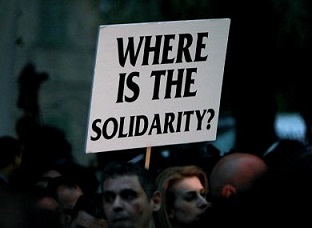
Protesters chant slogans outside the Cypriot parliament against a
plan to seize a part of depositors' bank savings, in central Nicosia.

Stephen Lendman: Grand Theft Cyprus (Part I)

Cypriot legislators rejected Plan A. At issue was taxing savings accounts over 100,000 euros 9.9% and small depositors 6.75%. Plan B followed.

On March 21, the Financial Times headlined "Cyprus targets big depositors in bank plan," saying:

On Friday, Cypriot legislators will "debate a 61-page bill on the banking system….(L)awmakers (say) they need more time…."

Seven other bills were tabled. One included banking activity restrictions. Issues regarding check cashing and other transactions were addressed.

The Wall Street Journal headlined "Clock Ticks on Cyprus," saying:

Legislators will consider a plan "to restrict noncash transactions, curtail check checking, limit withdrawals and even convert checking accounts into fixed-term deposits…."

Time is short. On March 21, the ECB said emergency liquidity (ELA) ends Monday. It'll do if agreement isn't reached on raising billions of euros internally.


A Safe and a Shotgun or Publicly-owned Banks? The Battle of Cyprus

Ellen Brown

If these worries become really serious,...[s]mall savers will take their money out of banks and resort to household safes and a shotgun. ~ Martin Hutchinson on the attempted EU raid on deposits in Cyprus banks

The deposit confiscation scheme has long been in the making. US depositors could be next...

On Tuesday, March 19, the national legislature of Cyprus overwhelmingly rejected a proposed levy on bank deposits as a condition for a European bailout. Reuters called it “a stunning setback for the 17-nation currency bloc,” but it was a stunning victory for democracy. As Reuters quoted one 65-year-old pensioner, “The voice of the people was heard.”

The EU had warned that it would withhold €10 billion in bailout loans, and the European Central Bank (ECB) had threatened to end emergency lending assistance for distressed Cypriot banks, unless depositors – including small savers – shared the cost of the rescue. In the deal rejected by the legislature, a one-time levy on depositors would be required in return for a bailout of the banking system. Deposits below €100,000 would be subject to a 6.75% levy or “haircut”, while those over €100,000 would have been subject to a 9.99% “fine.”

The move was bold, but the battle isn’t over yet. The EU has now given Cyprus until Monday to raise the billions of euros it needs to clinch an international bailout or face the threatened collapse of its financial system and likely exit from the euro currency zone.


Fiscal Cliff: Time to Call Their Bluff

Ellen Brown

The “fiscal cliff” has all the earmarks of a false flag operation, full of sound and fury, intended to extort concessions from opponents. Neil Irwin of the Washington Post calls it “a self-induced austerity crisis.” David Weidner in the Wall Street Journal calls it simply theater, designed to pressure politicians into a budget deal:

The cliff is really just a trumped-up annual budget discussion. . . . The most likely outcome is a combination of tax increases, spending cuts and kicking the can down the road.

Yet the media coverage has been “panic-inducing, falling somewhere between that given to an approaching hurricane and an alien invasion.” In the summer of 2011, this sort of media hype succeeded in causing the Dow Jones Industrial Average to plunge nearly 2000 points. But this time the market is generally ignoring the cliff, either confident a deal will be reached or not caring.

The goal of the exercise seems to be to dismantle Social Security and Medicare, something a radical group of conservatives has worked for decades to achieve. But with the recent Democratic victories, demands for “fiscal responsibility” may just result in higher taxes for the rich, without gutting the entitlements.

The problem is that no deal is going to be satisfactory. If we go over the cliff, taxes will be raised on everyone, and GDP is predicted to drop by 3%. If a deal is reached, taxes will be raised on some people, and some services will be cut. But the underlying problems – high unemployment and a languishing economy – will remain. More effective solutions are needed.


From North Dakota to Scotland: Exploring the Public Bank Option

Ellen Brown

The Royal Bank of Scotland (RBS) and the Bank of Scotland have been pillars of Scotland’s economy and culture for over three centuries. So when the RBS was nationalized by the London-based UK government following the 2008 banking crisis, and the Bank of Scotland was acquired by the London-based Lloyds Bank, it came as a shock to the Scots. They no longer owned their oldest and most venerable banks.

Another surprise turn of events was the triumph of the Scottish National Party (SNP) in the 2011 Scottish parliamentary election. Scotland is still part of the United Kingdom, but it has had its own parliament since 1999, similar to U.S. states. The SNP has rallied around the call for independence from the UK since its founding in 1934, but it was a minority party until the 2011 victory, which gave it an overall majority in the Scottish Parliament.

Scottish independence is now on the table. A bill has been introduced to the Scottish Parliament with the intention of holding a referendum on the issue in 2014.

Arguments in favor of independence include that it will allow the Scottish people to make decisions for Scotland themselves, on such contentious issues as having nuclear weapons in their seas and being part of NATO. They can also directly access the profits from the North Sea oil off Scotland’s coast.

Arguments against independence include that Scotland’s levels of public spending (which are higher than in the rest of the UK) would be difficult to sustain without raising taxes. North Sea oil revenues will eventually decline.

One way budgetary problems might be relieved would be for Scotland to have its own publicly-owned bank, one that served the interests of the Scottish people. True economic sovereignty means having control over the national currency, credit and debt.


It’s the Interest, Stupid! Why Bankers Rule the World

Ellen Brown

Interest charges are a strongly regressive tax that the poor pay to the rich. A public banking system could realize savings up to 40 percent - allowing taxes to be cut, services increased and market stability created - with banks feeding the economy rather than feeding off it.

In the 2012 edition of Occupy Money released last week, Professor Margrit Kennedy writes that a stunning 35% to 40% of everything we buy goes to interest. This interest goes to bankers, financiers, and bondholders, who take a 35% to 40% cut of our GDP. That helps explain how wealth is systematically transferred from Main Street to Wall Street. The rich get progressively richer at the expense of the poor, not just because of “Wall Street greed” but because of the inexorable mathematics of our private banking system.

This hidden tribute to the banks will come as a surprise to most people, who think that if they pay their credit card bills on time and don’t take out loans, they aren’t paying interest. This, says Dr. Kennedy, is not true. Tradesmen, suppliers, wholesalers and retailers all along the chain of production rely on credit to pay their bills. They must pay for labor and materials before they have a product to sell and before the end buyer pays for the product 90 days later. Each supplier in the chain adds interest to its production costs, which are passed on to the ultimate consumer. Dr. Kennedy cites interest charges ranging from 12% for garbage collection, to 38% for drinking water to, 77% for rent in public housing in her native Germany.

Her figures are drawn from the research of economist Helmut Creutz, writing in German and interpreting Bundesbank publications. They apply to the expenditures of German households for everyday goods and services in 2006; but similar figures are seen in financial sector profits in the United States, where they composed a whopping 40% of U.S. business profits in 2006. That was five times the 7% made by the banking sector in 1980. Bank assets, financial profits, interest, and debt have all been growing exponentially.


Fixing the Mortgage Mess: The Game-changing Implications of Bain v. MERS

Ellen Brown

Two landmark developments on August 16th give momentum to the growing interest of cities and counties in addressing the mortgage crisis using eminent domain:

(1) The Washington State Supreme Court held in Bain v. MERS, et al., that an electronic database called Mortgage Electronic Registration Systems (MERS) is not a “beneficiary” entitled to foreclose under a deed of trust; and
(2) San Bernardino County, California, passed a resolution to consider plans to use eminent domain to address the glut of underwater borrowers by purchasing and refinancing their loans.

MERS is the electronic smokescreen that allowed banks to build their securitization Ponzi scheme without worrying about details like ownership and chain of title. According to trial attorney Neil Garfield, properties were sold to multiple investors or conveyed to empty trusts, subprime securities were endorsed as triple A, and banks earned up to 40 times what they could earn on a paying loan, using credit default swaps in which they bet the loan would go into default. As the dust settles from collapse of the scheme, homeowners are left with underwater mortgages with no legitimate owners to negotiate with. The solution now being considered is for municipalities to simply take ownership of the mortgages through eminent domain. This would allow them to clear title and start fresh, along with some other lucrative dividends.


:: Next >>