












Ida B. Wells: Crusade for Justice
Jennifer Mcbride
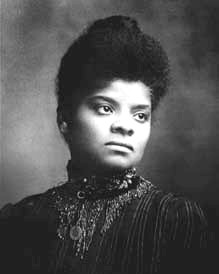
[Ida B. Wells has been described as a crusader for justice, and as a defender of democracy. Wells was characterized as a militant and uncompromising leader for her efforts to abolish lynching and establish racial equality. Wells challenged segregation decades before Rosa Parks, ran for Congress and attended suffrage meetings with the likes of Susan B. Anthony and Jane Addams, yet most of her efforts are largely unknown due to the fact that she is African American and female.]
Ida B. Wells was born July 16, 1862 in Holly Springs, Mississippi, during the second year of the Civil War (Sterling 61). Her parents, James and Elizabeth Wells, were slaves, and thus Wells, a woman who devoted her life to promoting racial equality, was born a slave. It was from her parents that Wells developed an interest in politics and her unwavering dedication to achieving set goals. After emancipation, Jim Wells became heavily involved in politics. He was a member of the Loyal League (a local black political organization), he attended public "speakings" on the steps of the courthouse, and campaigned for local black political candidates (Sterling 65). Jim Wells' fervent interest in racial justice and political activism no doubt inspired his daughter's later interest in these same issues. Elizabeth Wells was a religious woman and a strict disciplinarian who dictated a strong work ethic. Both Jim and Elizabeth Wells emphasized the importance of education. After the Civil War, 90% of blacks were illiterate. Emancipation brought about the legalization of Negro education, and shortly thereafter, Negro schools were established throughout the south. Shaw University was established in Holly Springs in 1866 to provide education for the large, rural black community of the area (Duster 9). Wells along with her siblings and her mother (who wanted to learn to read the bible) attended Shaw University. She notes in her autobiography that "our job was to go to school and learn all we could" (Duster 9). During her years at Shaw, Wells developed an intense love of words. She reportedly read every book in the school library, from the novels of Louisa May Alcott and Charles Dickens to the Oliver Optic stores, a series of popular books for boys (Sterling 65). Early on in her education, Wells discovered a bias. At Shaw she learned mainly European history, and Wells notes in her autobiography that "I had read the bible and Shakespeare through, but I had never read a Negro book or anything about Negroes" (Duster 22).